
Birding in Las Tangaras Reserve
I recently had the opportunity to hike into an Andean Cock of the Rock lek in the cloud forests of Mindo, Ecuador, while birding in Las Tangaras Reserve. Here, on the western slope of the Andes, we find Rupicola peruvianus sanguinolentus, the only area of the world where these birds are colored a brilliant scarlet red. On the eastern side of the Andes and throughout Peru, they are more orange in color. Easily disturbed by human activity, it is difficult to get a look at the crested males who dance in the treetops, performing vigorous confrontation displays for onlooking females. We had to get high above them, get into a hide, and look down into the canopy to see them.
The expression “the early bird gets the worm” is appropriate here, as the dancing starts at day’s first light. This required me to be on the muddy trail hiking in with a headlamp at 4:15am. Thanks to Marcos, the owner of the hostel I was staying at in Mindo, I had a ride up to the reserve where we parked at the trailhead. Marcos, a native to Mindo, had always dreamed of seeing the Cock of the Rock but still had never gone.
I will never forget the frog-like croaking and vibrant colors of an estimated 18 males using the lek that morning. We can thank the Cock of the Rock for being one of the most important seed dispersal agents of the Andean cloud forests, generating new growth year after year.
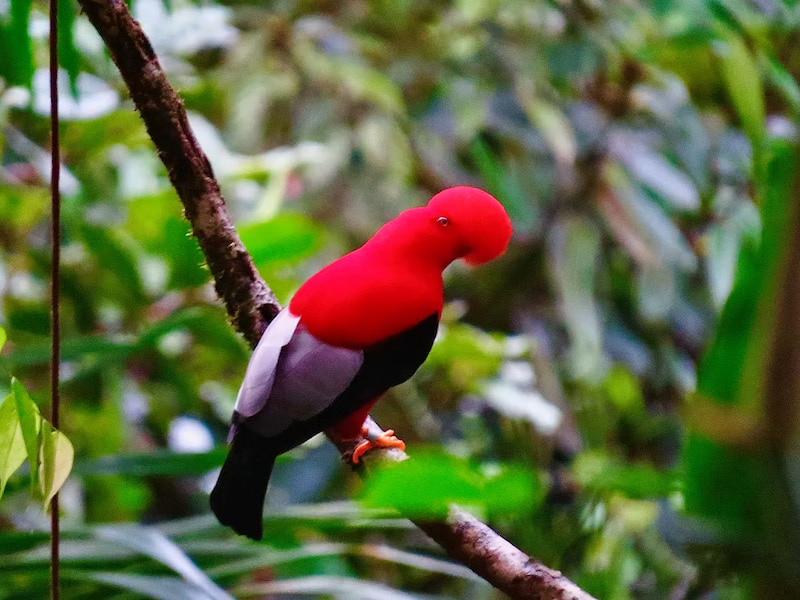
A male Andean Cock of the Rock (Rupicola peruvianus sanguinolentus) displays for females at a lek at Las Tangaras Reserve in Mindo, Ecuador. The band on its right leg was placed there by reserve volunteers
After the activity at the lek subsided, we worked our way down the hillside and started a great day of birding. Within minutes of each other, we were treated to several glimpses of a Choco Toucan (Ramphastos brevis) and a pair of Guayaquil Woodpeckers (Campephilus guayaquilensis).
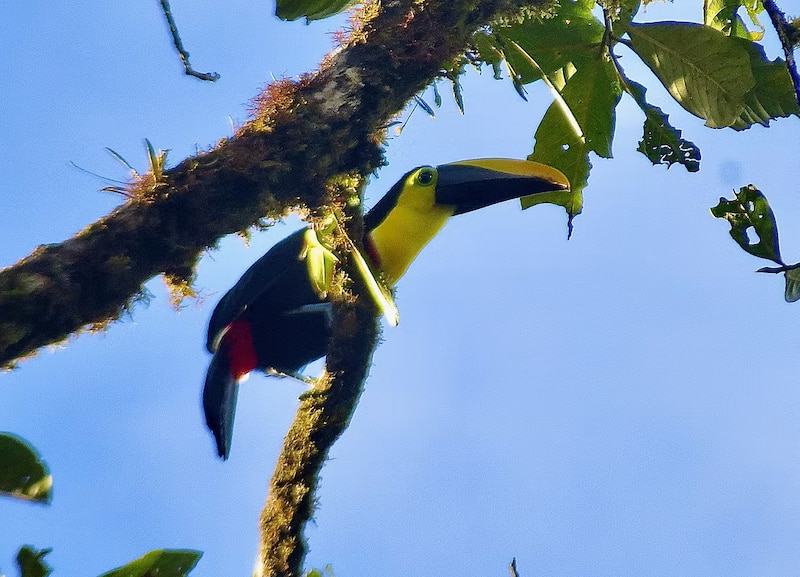
The Choco Toucan (Ramphastos brevis) is found in the Choco Biodiversity Hotspot in lowland and foothill forests of western Colombia and Ecuador. It was previously considered a sub-species of the Yellow-throated Toucan () but has now been separated. It has black on the mandible instead of chestnut, which can be difficult to distinguish in poor light. The best way to tell the difference is by voice: it makes more of a rasping or croaking instead of a yelping
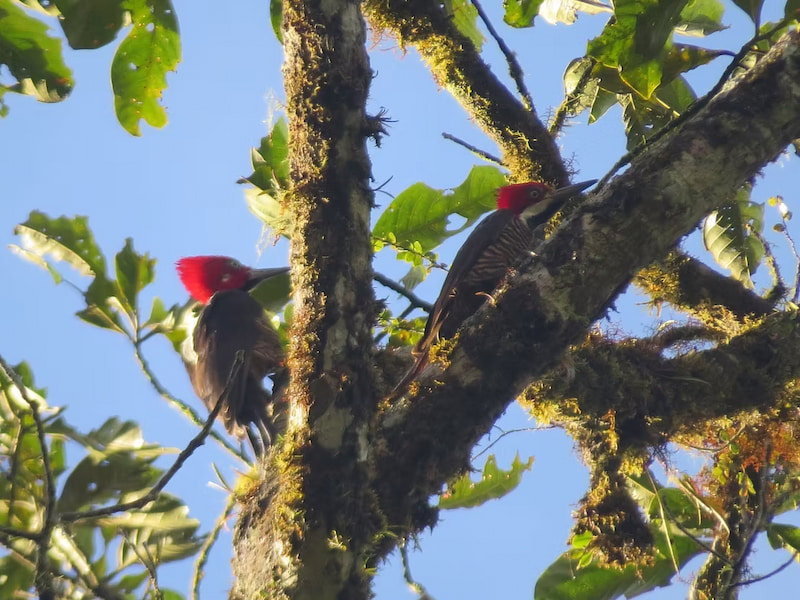
This pair of Guayaquil Woodpeckers (Campephilus guayaquilensis) put on a wonderful show in the canopy above us. The male (left) has a white spot on the cheek, while the female (right) has a white line across the face. This species can be easily differentiated from the Lineated Woodpecker (Dryocopus lineatus) because it does not have a black stripe through the eye and the white stripes come together on the back. Its range is distinct from similar-looking Crimson Crested Woodpecker (Campephilus melanoleucos)and Red-necked Woodpecker (Campephilus rubricollis)
My bird list includes 14 different hummingbirds, most of which were spotted at the feeders near the cabin’s porch. One of the species we saw away from the feeders was a Gorgeted Sunangel (Heliangelus strophianus). Unfortunately, I couldn’t get a good photo or appreciate its beauty because of the very dim lighting. Another species I saw away from the feeder I was able to photograph. This Green-fronted Lancebill (Doryfera leudovicae) landed in front of me on a branch overhanging a river.

The Green-fronted Lancebill (Doryfera leudovicae) is a large forest hummingbird with a very straight bill and bronzy nape. It most commonly associates with montane streams.
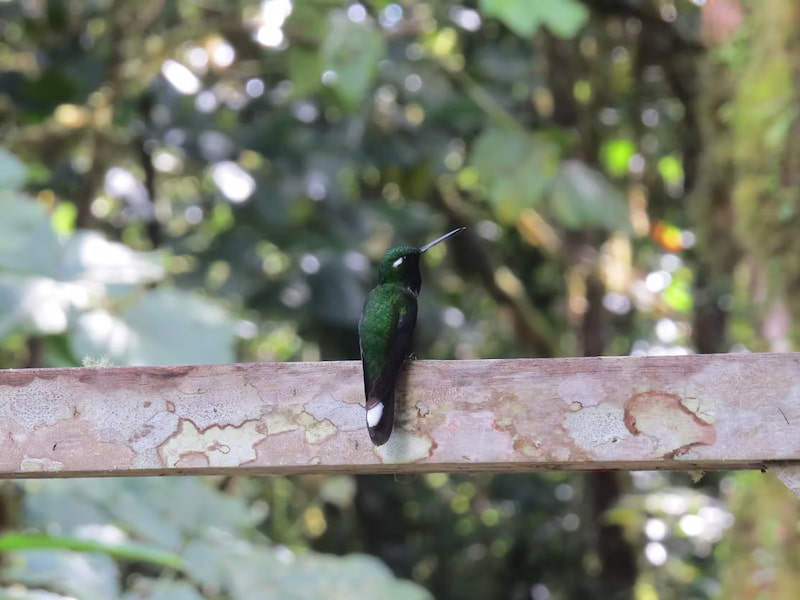
The Purple-bibbed Whitetip (Urostichte benjamini) is one of the more common hummers near the feeders at Las Tangaras. Notice the short white line behind the eye. The male has a prominent purple throat patch and white tips to the inner tail feathers that form a round spot in the middle of the tail. The female is spangled green with white tips on the outer tail feathers
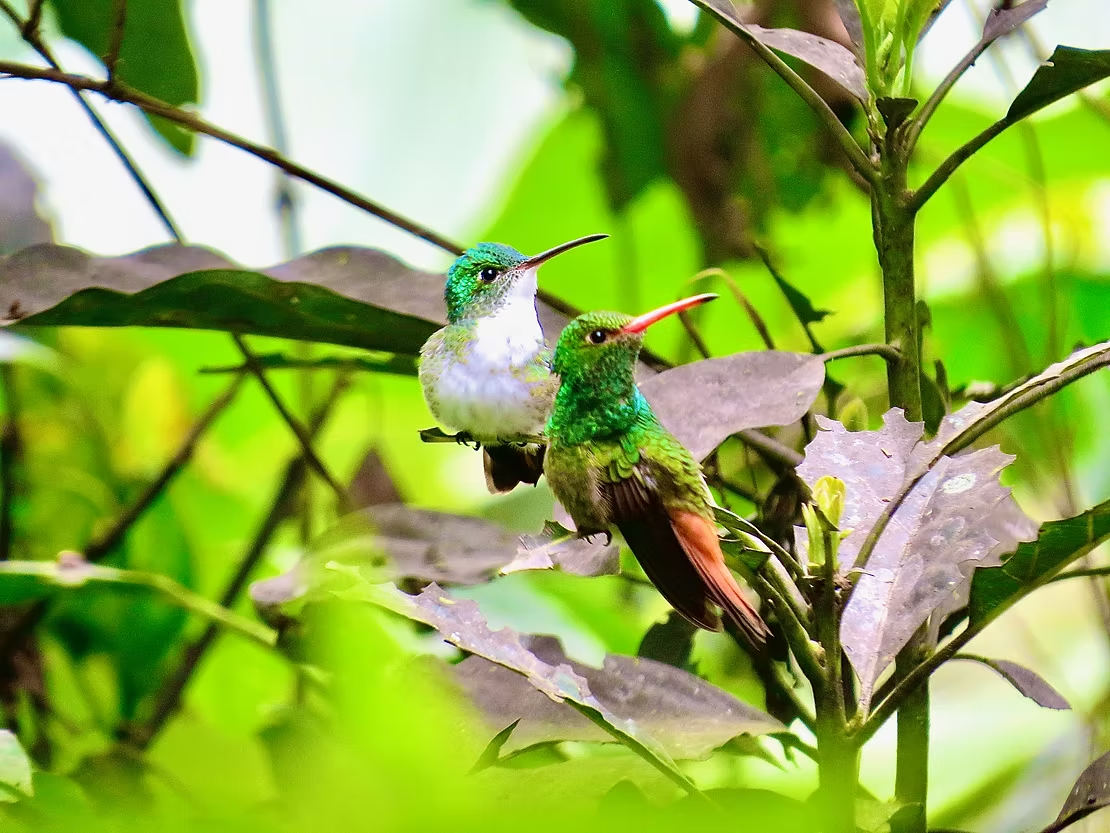
The Andean Emerald (Amazilia franciae), seen on the left, is unique in its range due to its clean white breast. The crown is blue on the male and green on the female. The Rufous-tailed Hummingbird (Amazilia tzacatl), to the right, has a green body, rufous tail, and almost straight red bill with a black tip
Another species that always dazzles the senses is the Red-headed Barbet (Eubucco bourcierii). I photographed this male and we made our way down the trail.
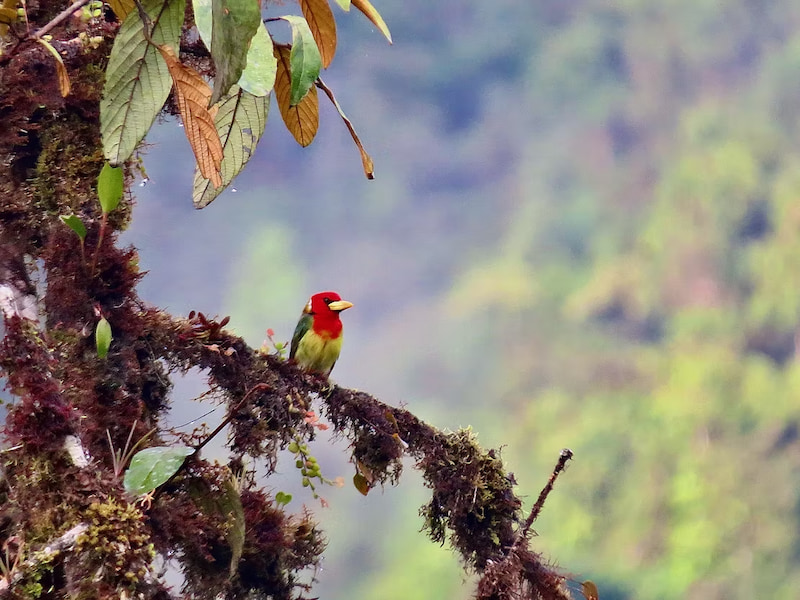
The male and female Red-headed Barbet (Eubucco bourcierii) are a good example of sexual dimorphism. When seeing the female, I’ve often thought I was looking at an entirely different species. The female has a blue cheek, yellow crown and nape, and a black mask
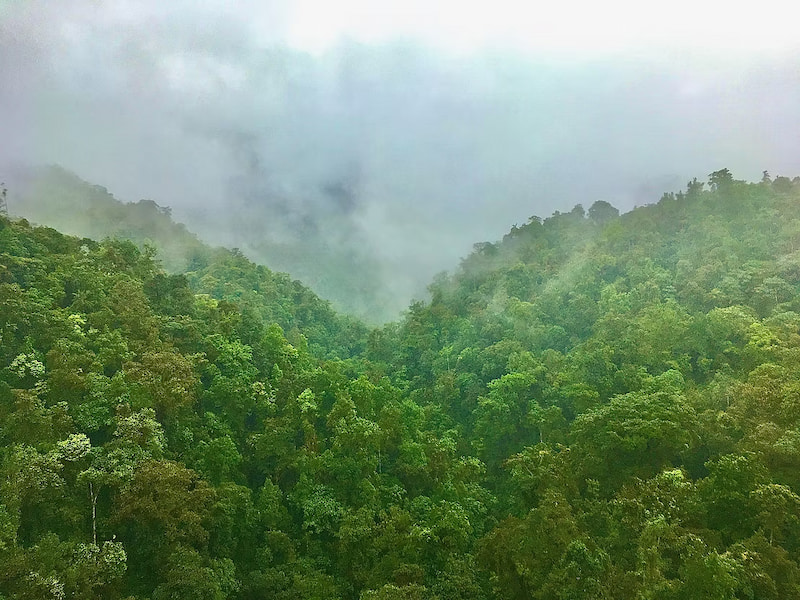
The cloud forests of Mindo, Ecuador get most of their precipitation from the low-lying clouds. The area ranges from 960 to 3,440 meters above sea level and occurs in an area where the Choco lowlands meet the Tropical Andes
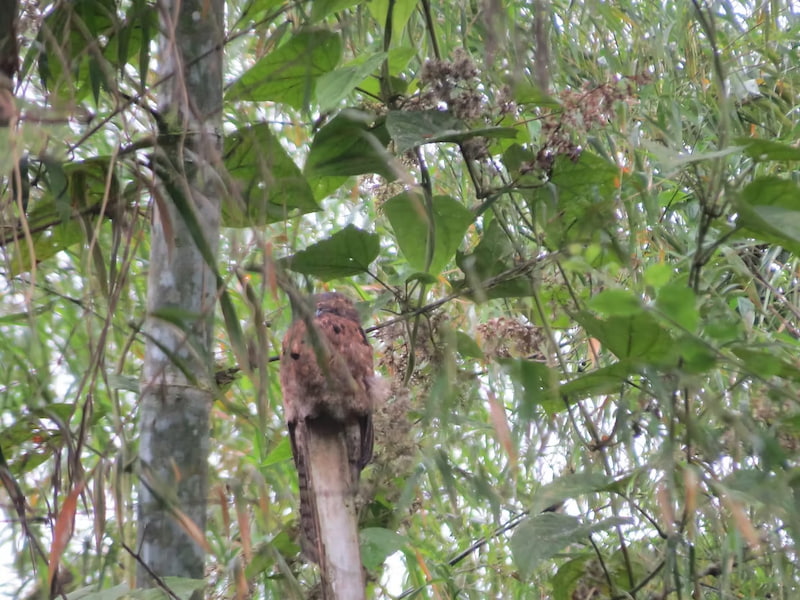
A Common Potoo (Nyctibius griseus) is a barely noticeable extension of this branch. This species is in the Nightjar family and is a close relative of the owl. It is nocturnal and hunts a little like a flycatcher, sallying out to catch flying insects and returning to the same spot. It has a haunting song, heard especially on moonlit nights that gradually descends in pitch

Conservation efforts in Las Tangaras Reserve
After descending from the Cock-of-the-rock lek, Marcos and I joined reserve managers Henry and Bridget in their morning mist-netting effort to band the reserve’s birds. This allows them to learn more about bird migration patterns, movement, and site fidelity. We hauled three volleyball-like nets down from the cabin and set them up in different locations throughout the property.

Marcos and I joined Henry and Bridget to set up a mist net to capture birds on the wing in Las Tangaras reserve
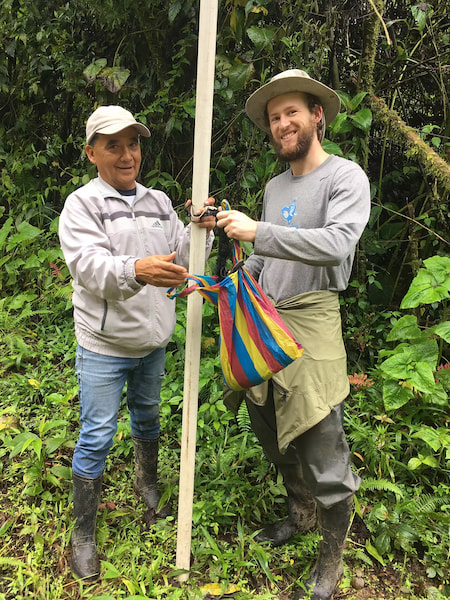
Henry and Marcos carefully unravel one of the mist nets
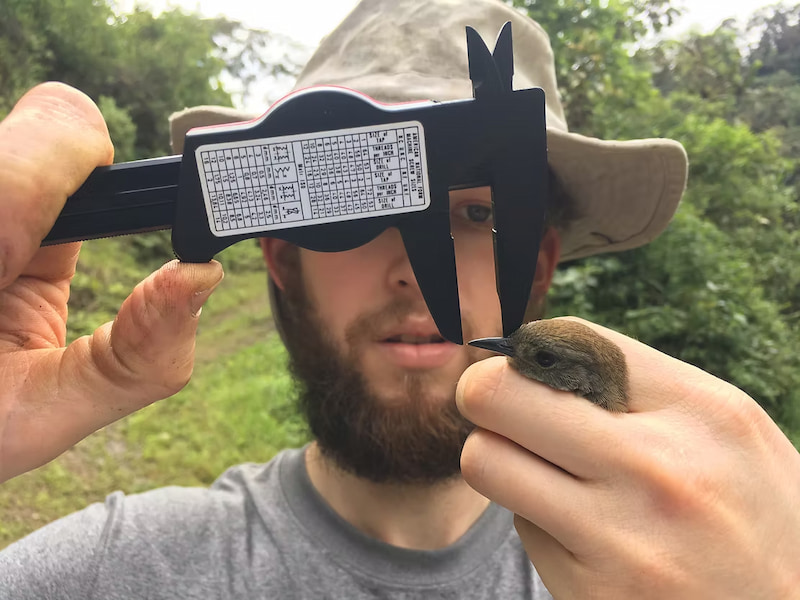
Henry measures the bill size on a juvenile Slaty Spinetail (Synallaxis brachyura)
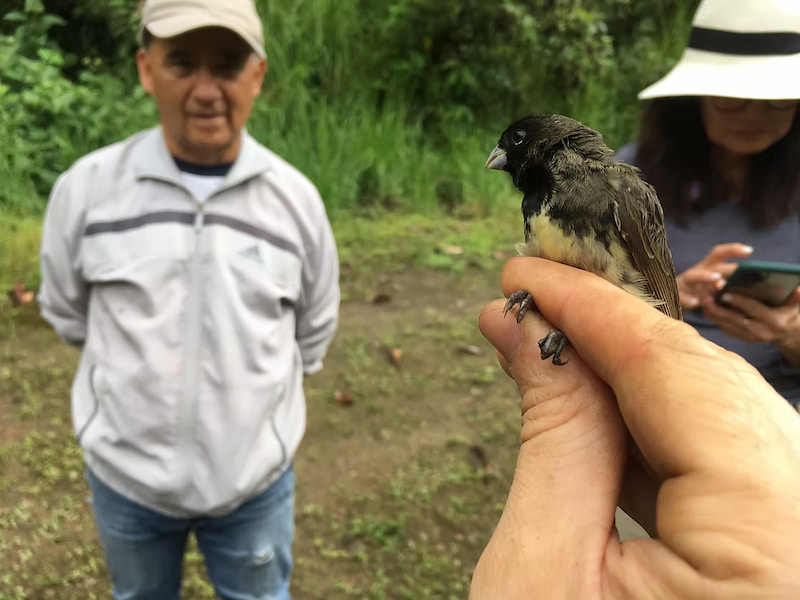
The yellow-bellied Seedeater (Sporophila nigricollis) male is fairly distinctive, with a yellow to pale belly and dark face and breast. The female is brown and very difficult to identify, unless seen with her male counterpart
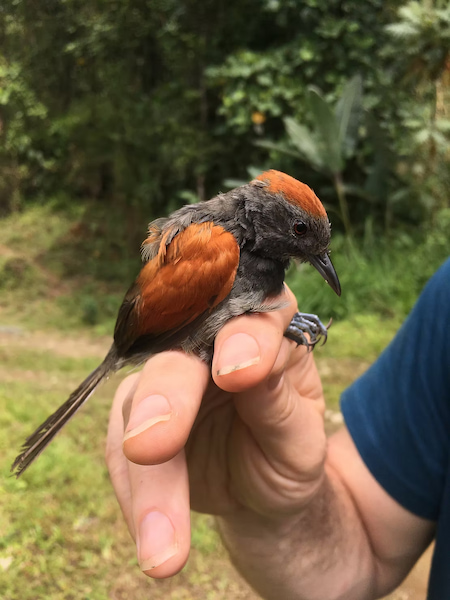
The Slaty Spinetail (Synallaxis brachyura) often stays hidden in dense low-lying vegetation and brambles
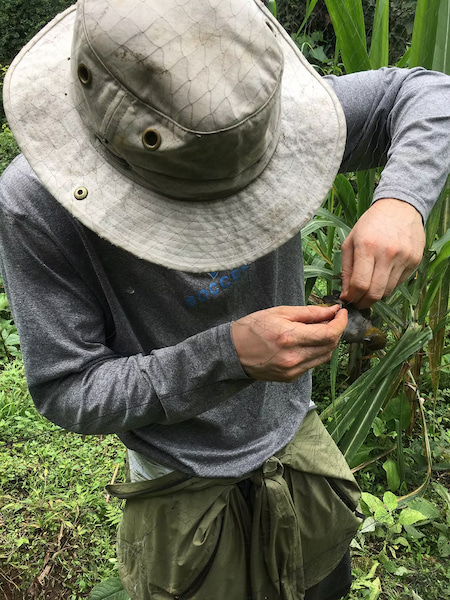
Henry extracts a Yellow-throated Chlorospingus (Chlorospingus flavigularis) from the mist net
You don’t have to ask Marcos to learn that the opportunity to view a wild Andean Cock of the Rock lek is the experience of a lifetime. Coupling this adventure with a morning of birding and banding provided an intimate look into the wild world of Andean cloud forest birds that I will never forget.
Las Tangaras Reserve keeps a lovely blog on their research efforts. It can be found here: https://lastangaras.wordpress.com/2020/04/28/a-scientific-tidbit/
Bird List
- White-necked Jacobin
- Brown Inca
- Booted Racket-tail
- White-whiskered Hermit
- Gorgeted Sunangel
- Purple-bibbed Whitetip
- Fawn-breasted Brilliant
- Green-crowned Brilliant
- Green-fronted Lancebill
- Empress Brilliant
- Purple-throated Woodstar
- Crowned Woodnymph
- Andean Emerald
- Rufous-tailed Hummingbird
- Turkey Vulture
- Black Vulture
- Common Potoo
- Red-headed Barbet
- Choco Toucan
- Guayaquil Woodpecker
- Lineated Woodpecker
- Russett Antshrike
- Plain-Brown Woodcreeper
- Buff-front Foliage-gleaner
- Red-faced Spinetail
- Slaty Spinetail
- Club-winged Manakin
- Andean Cock-of-the-rock
- Dusky-capped Flycatcher
- Black Phoebe
- Tropical Kingbird
- Yellow-throated Chlorospingus
- Slate-throated Redstart
- Summer Tanager
- Flame-rumped Tanager
- Blue-gray Tanager
- Palm Tanager
- Rufous-throated Tanager
- Beryl-spangled Tanager
- Golden Tanager
- Orange-bellied Euphonia
- Yellow-bellied Seedeater
- Bananaquit
- Buff-throated Saltator
- Black-winged Saltator
Make sure to check out our tours to Ecuador that we run at least once a year and other international tours! We provide some of the best guides & experience in the industry. See for yourself from the reviews we’ve received on TripAdvisor!
